Marching French Horn
The marching French horn is an enigma. Sure, it’s been used by high school marching bands and drum and bugle corps, but there are very few recordings of them on the Internet. They also carry a bad reputation with them…they’re impossible to march with, they sound worse and not as loud as a mellophone, and are generally pointless. Or so people say.
Some of these claims do have some truth to them. Picking out pitches on a horn in Bb or low G with a narrow horn rim while running around a football field is certainly not easy, and the drum corps “Frenchie” lines earned notoriety for lots of cracked notes. The marching horn (regardless of key) also does fall short of the mellophone in terms of raw decibel output. Additionally, band directors often don’t know what to do with them. Do they read Bb parts or F? (The correct answer is F. Always F.) Are they worth the additional expense over a mellophone? Why do some have bent leadpipes and some don’t?
Despite all this, I think the marching horn is unfairly maligned. A good marching horn with the right player and mouthpiece behind it really does sound pretty close to a “real” horn, and you certainly can’t get that sound with a mellophone.
It is also important to understand the marching horn’s integral role in drum corps G bugle hornlines before the legalization of 3 valves. While mid-voice instrumentation in drum corps back then was full of experimentation, French horns were a common choice. Why? Because being twice as long as the G mellophones (or flugelhorns, alto bugles, or meehaphones) meant that they could access many crucial notes in the mid-register that simply did not exist on the other 2-valve alto instruments. This was huge for the arrangers of the time, and a good French horn line added a huge amount of depth and flexibility to a hornline.


However, the top corps had begun to streamline their mid-voice to just mellophones even before 3 valves were legalized in 1990. While the tonal colors of a varied mid-voice line were great, unifying to one type of instrument meant tuning and blend was much easier. That said, a few small French horn lines did survive briefly into the 3 valve era, most notably in the Cavaliers and Santa Clara Vanguard. Both lines used the Kanstul KHB-185 3-valve G French horn bugle, with 8 made for SCV and 6 made for the Cavaliers. It is likely that no other examples of the model were made (despite it remaining in the Kanstul catalog for most of the company’s life), which would mean there are only 14 in the world.
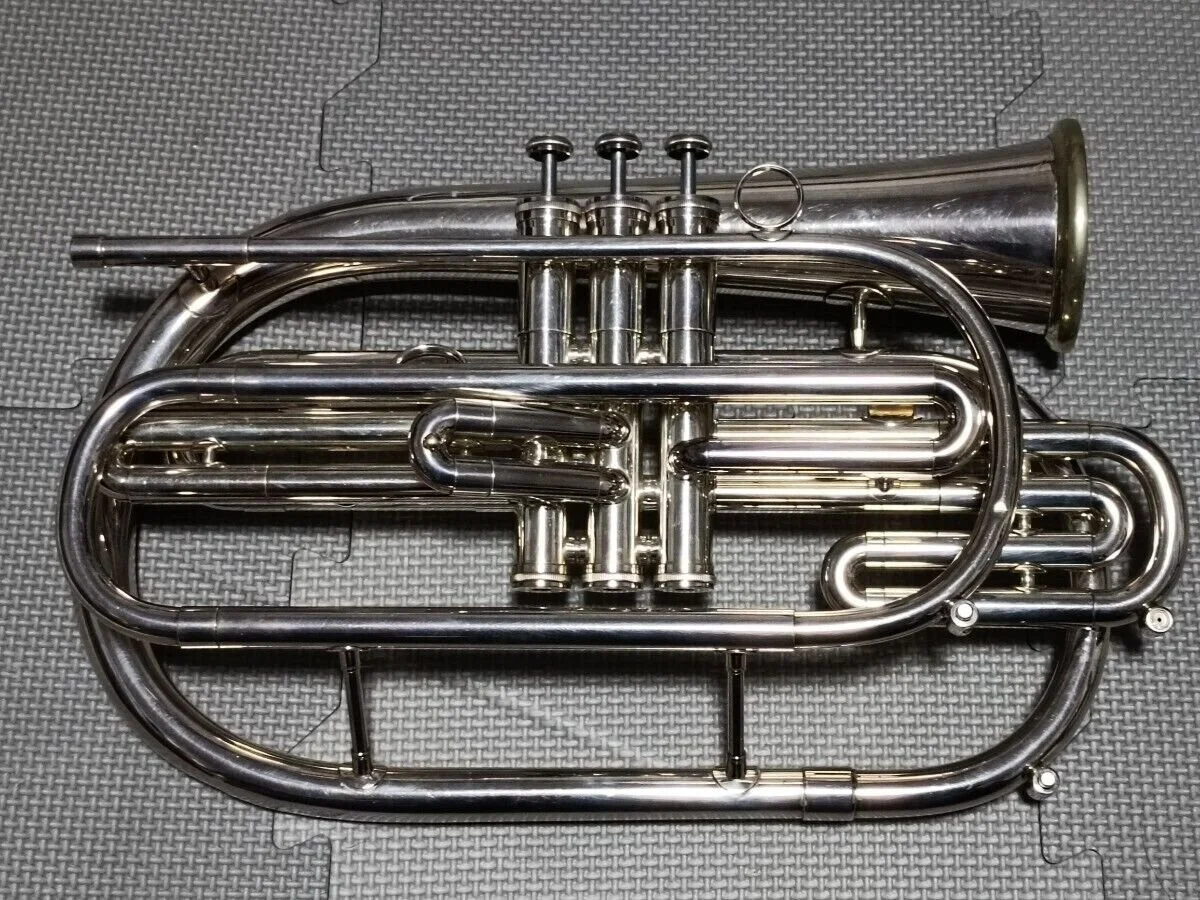
Here’s one!


This is the Kanstul KHB-185 I used to own, which was one of the Santa Clara Vanguard horns (it is even stamped as such on the bell!). SCV used these only through the 1992 season, after which they moved to all mellophones.
This horn is a great player. It is certainly not point-and-shoot like a mellophone; you have to work for the right notes just like on a single F horn (which is only a whole step lower). But the reward for your efforts is a bell-front instrument that really does sound like a French horn.
But don’t just take my word for it. Here’s a quick 8-part demo I recorded all on this Kanstul:
While the register of drum corps French horn parts meant that they really did not need a third valve, I certainly enjoyed getting to use the full range of the instrument in this bite-sized piece.
Being fully chromatic also means that an instrument like this could really be the solution for playing French horn into a mic that’s placed in front of you. I have played many gigs where I doubled on French horn, and the only solution with a normal horn is to physically turn 90 degrees to the left and hold the bell up the mic like you’re playing Mahler. It is awkward at best. A good marching horn like this Kanstul (which sounds like a horn, but points forward) is the perfect solution for a gigging brass doubler. However, I feel like the 185’s descendant, the KMH-285 in B-flat, is a better compromise for this purpose.
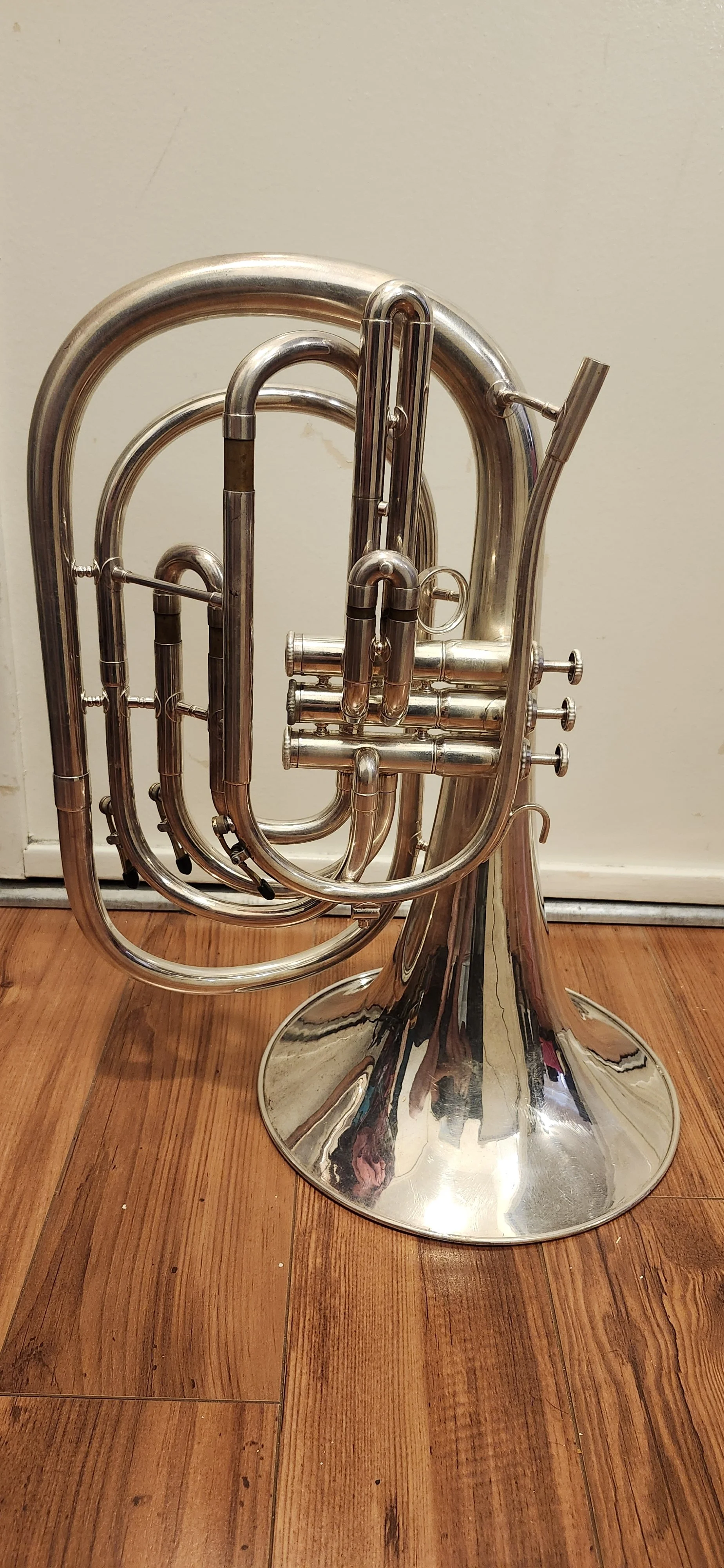
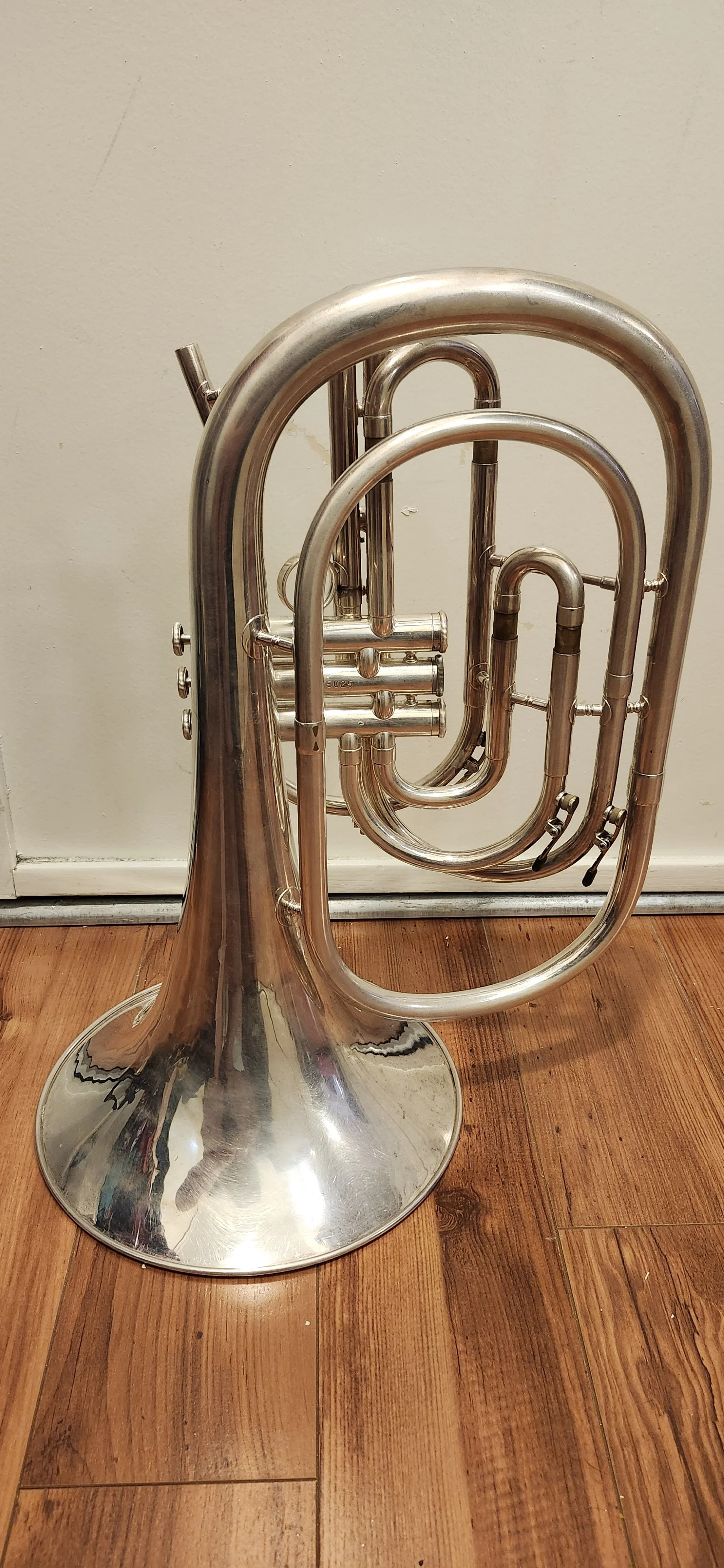
That’s my KMH-285! I got it years after selling the 185, and it’s exactly what I hoped for. It trades just a small bit of the authentic horn sound for much easier playability, and fingerings that I (along with most brass improvisers) am much more comfortable improvising in. This 285 is a wonderful instrument that plays very easily, still sounds like a “real” horn, and is the perfect instrument to bring to gigs where you really need the bell to point forward. I’m excited to use it in this capacity, as I usually have a handful of gigs per year that would benefit from such an instrument. I’m not the only freelancer here in LA with a 285, either; I played a recording session here in Los Angeles where everyone was on marching instruments and one of the mellophone players also played a Kanstul 285 some of the time, presumably to fatten up the section sound.
The only other non-marching band use of a marching horn I’ve seen is by the fabulous Solo Hornist of the Munich Philharmonic, Matias Piñeira. He has a custom small bell Bb marching horn, which appears to be an Otto 207 “La Revolución”, that he uses for salsa playing in addition to his normal Alexander 103. He uses both instruments in this video:


Here’s a brief trip through some other interesting types of marching French horns.
The third type of marching horn, after the B-flats and the Gs, is the high F marching horn. These are less common than the other two, and in my limited experience with my Dynasty M546 high F marching horn, I think that’s for good reason. They don't play very well, don’t really sound like a horn, and don’t have the power or ease of a mellophone. They feel like the worst of all worlds, and yet another unnecessary rehashing of the frumpet concept (though admittedly done more competently than the frumpet was). I will say that I doubt my Dynasty M546 is the pinnacle of high F marching horn design, as Kanstul did make a high F marching horn (model 284) to go alongside its B-flat and G marching horns. I haven’t had the chance to try a 284, but I don’t have high hopes based on how bad my Dynasty is. But, as with all attempts to make a high F marching instrument using a horn mouthpiece, I have a suspicion that all my Dynasty needs is to have the horn receiver swapped for a trumpet/mellophone receiver, and suddenly it’ll make sense. I plan to find out for myself soon enough.
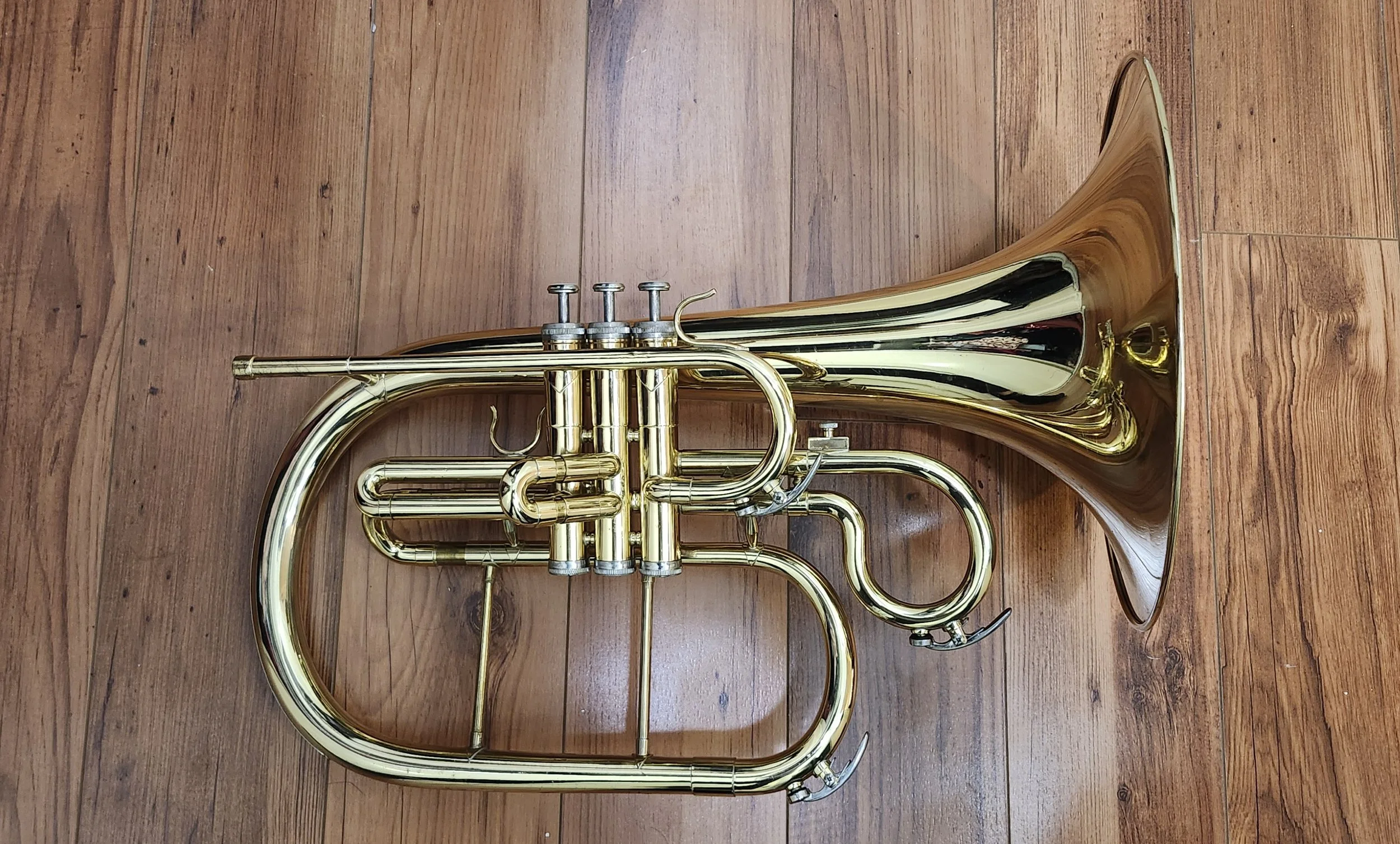

Other than the Kanstul 284 and Dynasty M546, Blessing was the other maker of high F marching horns. They even only made a high F marching horn, the M-400, and never bothered to make a B-flat. This has a mostly similar wrap to the Dynasty, though the lack of bottom braces is a large visual difference. The Dynasty almost appears to be a transitional instrument between the braceless Blessing design and the Kanstul 284 design, where the main tuning slide flanks to the right of the valves rather than left.
Kanstul and Dynasty no longer exist, and Blessing is a shell of its former self that certainly does not make the M-400 anymore. This means that no high F marching horns are being made anymore, and from my experience that’s probably a good thing! However, Conn-Selmer has decided to tarnish the high F’s already deservedly questionable reputation further, by releasing the totally half-hearted King KMH611. This instrument is literally just a King mellophone with a slightly angled French horn leadpipe and receiver stapled on. I have played it and it is the instrument that comes closest to the anemic sound and awful playability of the Getzen frumpet. It certainly does not sound like a horn, or anything else worth listening to. I hope Conn-Selmer doesn’t sell a single one.
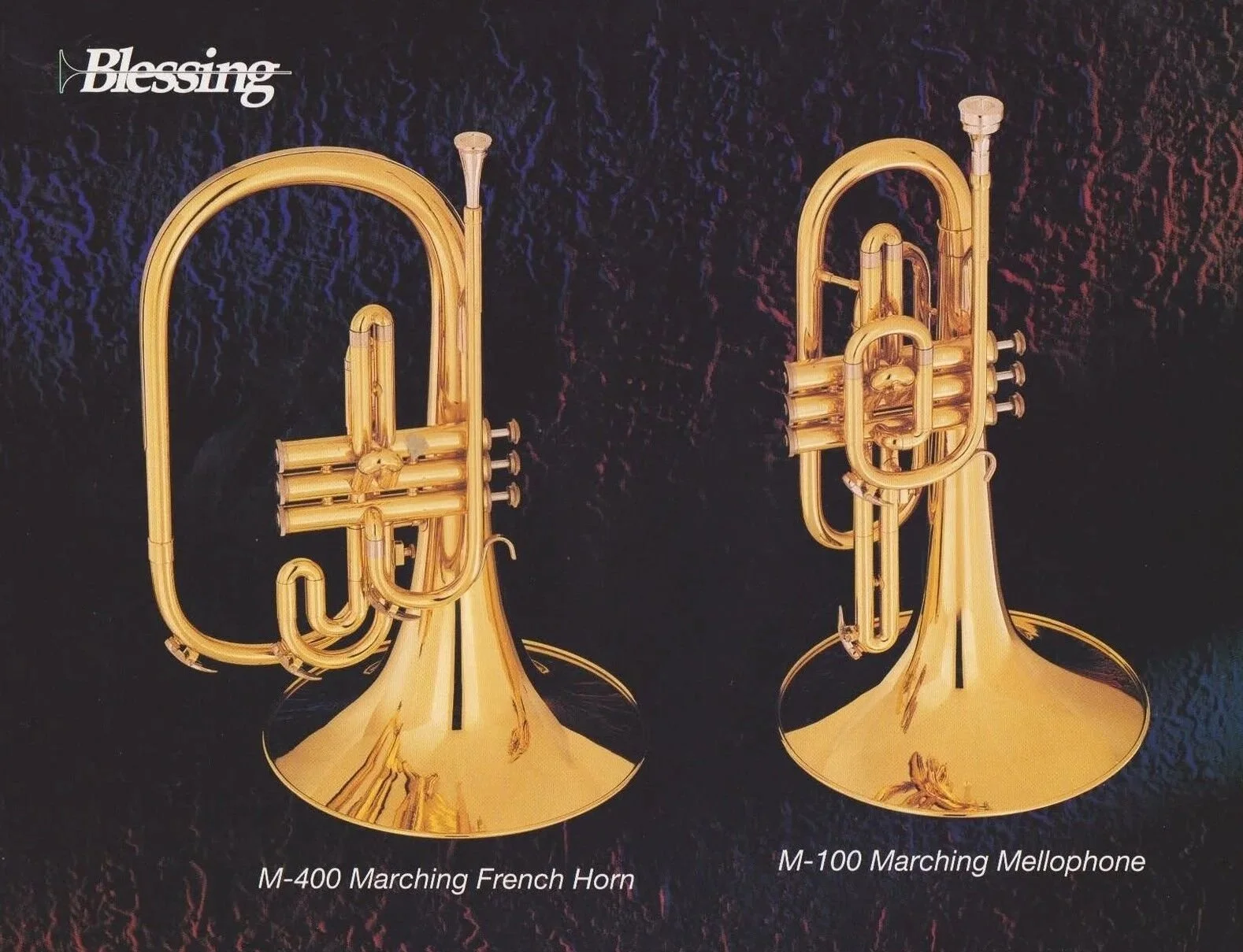
We’ve covered the Dynasty high F marching horn, but they of course made B-flat and G marching horns as well. Before the Dynasty B-flat marching horn became the more modern M551, the early models used the same basic wrap as the original Dynasty III G French horn bugle. The Adams MF1 has a similar wrap to the Dynasty M551, but the older DEG/Dynasty design doesn’t have any imitators that I’m aware of.

There have been some very odd-looking marching horns throughout history as well, such as the Holton MH-100, 101, and 102. These Dr. Seuss horns play as oddly as they look, but at the same time they play concerningly well. They have a trumpet mouthpiece shank for some reason, which allows you to put lots of different kinds of mouthpieces in it. Most confusingly, they have been copied by Jinbao. Every aspect of this instrument’s existence seems like it came out of a fever dream! And it’s not even the only one of this comical design; unbeknownst to most, Yamaha also made a circular marching horn in the Holton style: the ultra-rare YHR-301M.


Feast your eyes on this glorious Hans Hoyer 4-valve Bb marching horn, which is possibly the only 4-valve marching horn ever made, and certainly one of the only professional-quality bell-front horns in existence. My desire for one of these knows no bounds.
Finally, a discussion about marching horns cannot ever be truly complete without discussing the Patterson Hornette project. This was an attempt to create a new kind of bell-front French horn for use by horn players in jazz and popular music, in a similar vein to the Otto 207 referenced above. Unfortunately, despite Conn-Selmer being linked to the hornette project, it has been radio silence since the 2022 IHS Symposium.
The Patterson hornette
The Low Alto Bugle
Speaking of marching horns with trumpet shanks, Kanstul also made a very odd variant of the KHB-185 3-valve G French horn bugle presented at the beginning of the article. They called it a “Low Alto”, and it is the same as the KHB-185 except for a different leadpipe (trumpet shank) and main tuning slide arrangement. As weird as it is, 6 were built and it did see some drum corps use with the Marauders and later the Kingsmen Alumni.
Kanstul low alto bugle in G (no model number)
Because it has a trumpet shank, the low alto bugle can accept many different mouthpiece types. As I have adapters for both trumpet to horn and trumpet to cornet, I was able to see how it sounds with mouthpieces that use all 3 shanks. As it is a Kanstul G marching horn at heart, if you use a horn mouthpiece with an adapter it plays and sounds pretty much like the KHB-185 French horn bugle. It’s a little harder to play accurately and a little more work to get a centered horn sound (I suspect mostly due to the adapter), but it’s there if you work for it. And unlike the 185, the low alto has a whole toy chest of other sounds to explore by using different mouthpieces.
From my time with the low alto, I found that horn, tenor horn, alto trumpet, and very small trombone mouthpieces worked the best. I do think that a mouthpiece that truly matched the instrument well would have to be custom made. But rather than talking about it any longer, I’ll just let you listen. I recorded a small collection of short, improvised excerpts on 11 different mouthpieces (and adapters when required), each meant for a different instrument.
Lastly, here’s a back-to-back comparison of the 2 marching horns with trumpet shanks: the G low alto bugle with horn mouthpiece (via adapter) and the Holton MH-101 with horn mouthpiece (via adapter).