The State of Chinese Brass Instruments in 2026
It’s 2026, and opinions on Chinese brass instruments vary wildly, often from people who have never actually played one. Their well-earned reputation from decades past of being “instrument-shaped objects” and the like lingers, even though many modern Chinese brass instruments will go toe-to-toe with anything else out there. In this article, I’m going to try to give a summary of the state of Chinese brass instruments in 2026, using my experience both trying and owning many Chinese instruments over the years. In some ways the Chinese instrument industry is the same as it ever was, while in others it’s very different. Let’s try to set the record straight!
Let’s start with the bad, or what parts of that long-standing bad reputation are still deserved. The number one thing to be wary about from most Chinese makers is the complete lack of quality control. Buying direct from the manufacturer on Alibaba or AliExpress is a roll of the dice, as you don’t know if you’re going to get a good instrument or not and returning products on those services is a long, expensive process. For that reason it’s better to buy from somewhere like Thomann, which has excellent customer service and a great return policy. Even better is to buy from a distributor that performs their own quality control on instruments arriving from the factory, so you know you’re getting a good example. Wessex Tubas is probably the most well-known example of this type of company, and it goes well beyond just slapping its logo on otherwise-stock Jinbao instruments like most other retailers do. But there are far more places to buy from that are either a risk due to the nature of the process (Alibaba, AliExpress), or a risk due to having notoriously terrible customer support (Schiller/Jim Laabs).
If you’ve ever perused Alibaba or AliExpress, you’ll know that the variety of different brass instruments produced in the various Chinese factories (of which Jinbao is but one of many) is enormous. Apart from a few exceptions such as Wessex’s original models and a few others we’ll discuss later, these instruments are all clones of existing instruments from established brands. Yamaha clones abound, but there’s plenty of other variety, all the way down to instruments that leave you scratching your head wondering why on Earth they would pick that model to clone. My favorite example is the copy of the Holton MH-101 B-flat marching horn, which is an instrument nobody wanted when it was made and they still don’t want it now! And yet, it’s a standard model in Jinbao’s catalog, and has been on Schiller’s enormous roster for a long time.
The main thing to know about these clone instruments is that they are not all created equal, and it takes research and firsthand experience to know which clones are bad and which ones are good. This is separate from the quality control discussion, as even if you put equally-well-made examples of every model next to each other, some would play far better than others, partially because of the original designs and partially because of how well they are copied. Based on my experience, there are many good and even great clone models out there, and I’ve owned and gigged on many of them. Here’s a helpful list of some of the best Chinese clones I’ve played:
Yamaha YEP-642-style compensating euphonium (Wessex Dolce, Mack Brass 1150, Schiller Elite, etc.): No, this is not the best playing euphonium ever. But it just…works. More than a lot of expensive euphoniums do. It plays evenly in all registers, has intonation no more quirky than any other euphonium, and it sounds nice. It gets the job done and doesn’t ask questions while doing it, and that’s exactly what I need as a freelancer who gets the opportunity to take the euphonium out of the house maybe once or twice a year. But it sticks up to every demand I’ve thrown at it, including recording exposed solos for League of Legends. (All the euphonium solos laced throughout the new “For Demacia” season soundtrack are me on my $800 Schiller!) I actually replaced a lovely, one-of-a-kind Sterling Virtuoso euphonium with my Schiller, as the Schiller is easier, more predictable, and more even. Do I wish I could justify buying a really nice euphonium again? Of course, what euphonium player doesn’t?? But as a freelancer and not an international euphonium soloist, the Schiller is more than up to the task. I’ve heard the Besson Prestige clone (i.e. John Packer 374) is great too, but I’ve never played one myself.
British-style 3-valve compensating baritone horn (Jinbao JBBR-1240, Wessex BR140, etc.): I have tried this model back to back against Besson Prestige/Sovereign and Yamaha Neo baritones, and I actually thought the Jinbao played the best out of all of them. Exceeded, not just matched! I have owned a JBBR-1240 for several years and while it’s not perfect, it plays and sounds great and I have used it on many gigs and recordings. I’d like to try some of the high end baritones again at some point, but considering I paid less than $300 for my Jinbao, I doubt I’ll be rushing to replace it any time soon.
Yamaha YBH-621-style 3+1 non-compensating baritone horn: This horn is so much fun! It’s impossible to put down, it’s just a really fun horn to play with a great, colorful sound. I want one!
K&H Slokar-style alto trombone (Thomann SL-35, Selman 11303, the old Horn Guys Stauffer alto, etc.): These Chinese Slokar altos were EVERYWHERE 10-15 years ago, and lots of people bought them and learned how to play alto trombone on them. Back then your only options were one of these, or something very expensive. Lots of players chose the first option, and as a first or occasional alto (i.e. you don’t play principal in a working orchestra) these still hold up very well, especially with an aftermarket leadpipe. Nowadays there are more options, such as the Thomann TEB-480 which I have a theory is the same instrument as the revered JP Rath alto. I’ve tried the JP Rath, and while it didn’t blow me away it was a perfectly serviceable alto…though I’m not sure it’s worth spending $1k more than the Slokar clone, so if you want to try a couple cheap altos to see which one you like best, I’d recommend just going all Thomann and getting an SL-35 and a TEB-480.
British-style Eb tenor horn (Besson-style, not the Yamaha YAH-203 copy): I have played DOZENS of these Chinese tenor/alto horns (along with plenty of “real” professional models from established brands) and they always impress me. They play so well and sound great. I would own one in a heartbeat!
Malone-style S-leadpipe Eb/D trumpet (Jinyin A688): Plays great, intonation quirks in predictable places, nice sound, great response. I have no complaints, especially for the paltry price I paid!
Selman 17001 C trumpet (no idea what it’s a copy of, or the Jinbao model number): I have used my Selman C trumpet on countless gigs and recording sessions, and much like the Yamaha euphonium clone, it just works. Same alternate fingerings needed as a Bach, plays like a C trumpet, no nasty surprises. The only downside is it doesn’t really get that dark Bach sound that’s overwhelmingly in fashion, but for a first C trumpet, church gigs, a backup, or something for when you need a brighter sound than your Bach 229, it’s just a completely solid C trumpet. And I got mine for $85!
Every ZO tuba (plastic ones excluded): Seriously. Every single one is a winner.
In recent years, the big development in Chinese instruments is that it’s not just clones anymore. Some Chinese manufacturers have begun making their own original models. As mentioned before, a lot of Wessex’s catalog is “off script” so to speak, being original designs Wessex worked with the factory to develop and produce. But to me the best example of just how far Chinese brass instrument making has come is a newer company called Y-Fort. Y-Fort makes a small lineup of trumpets and trombones, and any time I’ve been at a Y-Fort booth at a convention I’ve overhead everyone trying their instruments (whether it’s a trumpet or trombone) raving about how nice they are and how great they play. I agree wholeheartedly with this assessment, and have yet to play a Y-Fort I didn’t like. But even more importantly, I’ve never played a Y-Fort that didn’t feel like a top quality professional instrument. It seems like they don’t compromise on any part of the design, and the trombones especially are not clones of any other instrument.
At NAMM 2023, I tried every large bore tenor trombone at the show. 1st place went to the Courtois New Yorker (a nearly $7,000 trombone, and front heavy), 2nd place to the Shires David Rejano artist model (~$6k), and 3rd place…was a Y-Fort 763L (under $2k). And it was NOT a distant 3rd! In fact, I liked the Y-Fort so much that I bought that 763L straight from the NAMM booth, and it’s still my main large tenor today. It’s one of the easiest-playing large tenors I’ve ever played, and eliminates most of the difficulty of playing large bore to me. Other large tenors make me feel that large tenor is the worst size of trombone by far, but the Y-Fort doesn’t give me that impression. It plays as predictably and easily as you could want from a trombone of any size. Once again…it just works! Many people have tried my Y-Fort tenor and have all been very impressed. It’s my personal opinion that if you’re in the market for a large bore tenor, and you don’t have boutique horn money ($6k+) to spend, your first consideration should be a Y-Fort 663 or 763. They are that good!
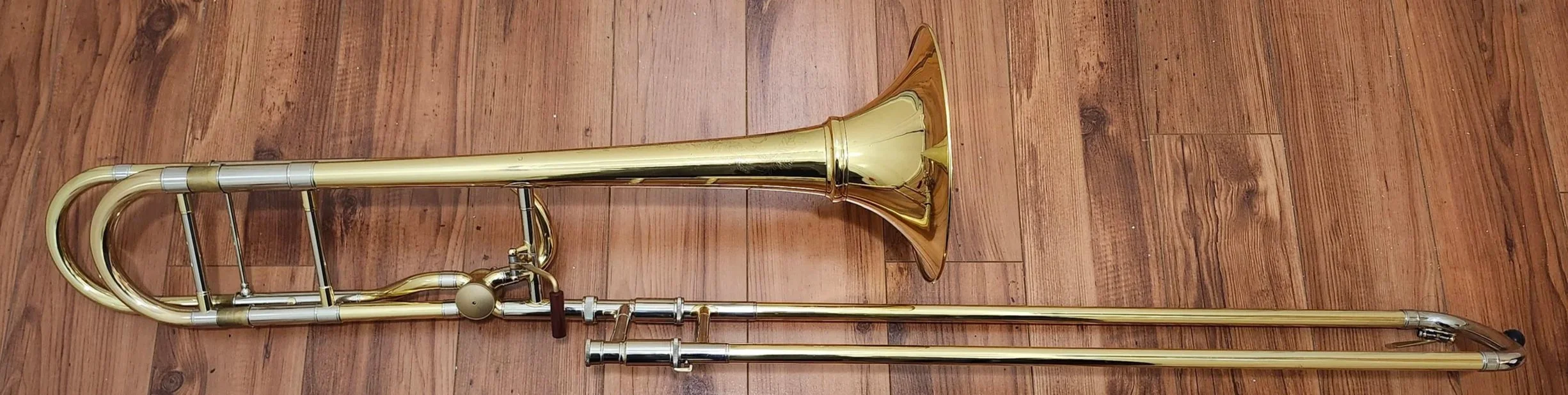
My Y-Fort YSL-763L, bought straight from the Y-Fort NAMM booth in 2023
Likely the modern Chinese instrument that people have the most experience with is the Shires Q series. The Q series was introduced in 2017, and slots just below the Custom line. Q series trombones are still modular, and you can swap Q parts with Custom parts and vice versa. Initially the Q series was manufactured in China but then assembled by Shires in Massachusetts, but nowadays the Q series is 100% manufactured and assembled in China. The Q series is also not the only high-quality Chinese-made line that Eastman-Shires sells; they’ve gone all in with the K series, the A series, and the Eastman 800-series (in descending price order). Though all of these lines (and even the Custom line, as nowadays even those instruments have some Chinese-made components) have some quality control issues, there are a LOT of really excellent Q, K, A, and 800-series instruments out there that meet the standard people expect from a hallowed name like Shires. Some standout models I can think of are the Q33 jazz tenor trombone, Q35 alto trombone, Q36 bass trombone, Q38 contrabass trombone, Q15 Eb trumpet, Q10 C trumpet, Q41 euphonium, K56 euphonium, Willson Q90 euphonium, Willson A27 euphonium, and Eastman 848 bass trombone.
Rath, another boutique modular trombone maker, has partnered with John Packer for awhile now to make two lines of Chinese-made instruments designed by Mick Rath: the JP Rath series and the Rath 00 series. Now that John Packer owns Rath outright, the John Packer → JP Rath → Rath 00 series → Rath Custom pipeline is all the more clear, and just like the Eastman-Shires Chinese lines, there are a lot of gems therein. The very bottom of the range, the John Packer 131 small tenor trombone, is a fantastic instrument, as is the JP Rath 231 that slots above it and the Rath R100 and R300 that slot above that. They are all excellent small or medium bore trombones that slot beautifully under Rath’s phenomenal handmade custom small and medium bores. The JP Rath 333 bass trombone is an excellent lighter weight, commercial-leaning bass trombone that I actually like better than some configurations of the custom Rath R9. The Rath R900 is another excellent bass trombone that plays a lot like a custom R9 and costs a lot less. I would buy a JP Rath 333 or a Rath R900 over many far more expensive bass trombones from established non-Chinese manufacturers. They are that good!
The point is, while there are still some “instrument-shaped object”-level Chinese brass instruments out there, there are far more that are at least decent, all the way up to those (Y-Fort, best of Shires Q series) that are as good as anything from an established maker. It’s time to shed the “Chinese = bad” trope and embrace that brass instrument manufacturing in China has transformed itself from a curiosity to a real market for players of all levels, just like Japan (=Yamaha) did starting in the 1970s, and Taiwan (=Jupiter/XO, and now Carol Brass) did a few decades later. India is still in the instrument-shaped object stage for now, but who knows? They might be the next to figure it out in a few decades from now.
I think the future of Chinese brass instruments is bright, but we don’t have to wait for that future to arrive to pay attention. They are already worthy of consideration right now!