Piccolo & Sopranino Trombones
If the soprano trombone isn’t comically small enough for you, you are in luck! There are technically three smaller members of the trombone family, though two are so rare they might as well not exist. Welcome to the absurd world of piccolo and sopranino trombones.
Let’s start with the piccolo trombone. This instrument is pitched in B-flat, one octave above the soprano trombone, two octaves above the tenor trombone, and the same length as a B-flat piccolo trumpet. It is hilariously tiny, and despite the fact that renowned brass maker Thein offers one, it is not at all a serious instrument. In my opinion, soprano trombones are about the limit of real musical usefulness for a trombone, and an instrument an octave higher is only useful as a toy and curiosity. Still, piccolo trombone is a real thing that exists, so let’s talk about it.
As mentioned, Thein makes a piccolo trombone. I would assume they first made one for the German Brass, who often use the piccolo trombone as a “show instrument” according to Thein’s website. But they decided to make it a standard offering, and for whatever reason it was then copied (roughly) by at least one Chinese instrument factory and is now sold by Wessex Tubas and other Chinese retailers. It is typically marketed as a toy that happens to be a functional instrument, which I believe is an accurate assessment. Wessex states that their piccolo trombone is “the perfect gift for special occasions such as birthdays or Christmas”, and “ideal for the light-hearted brass musician in your life”. And indeed, generally people buy a piccolo to have around as a fun toy or conversation piece, rather than aspiring to use it as a serious musical instrument.

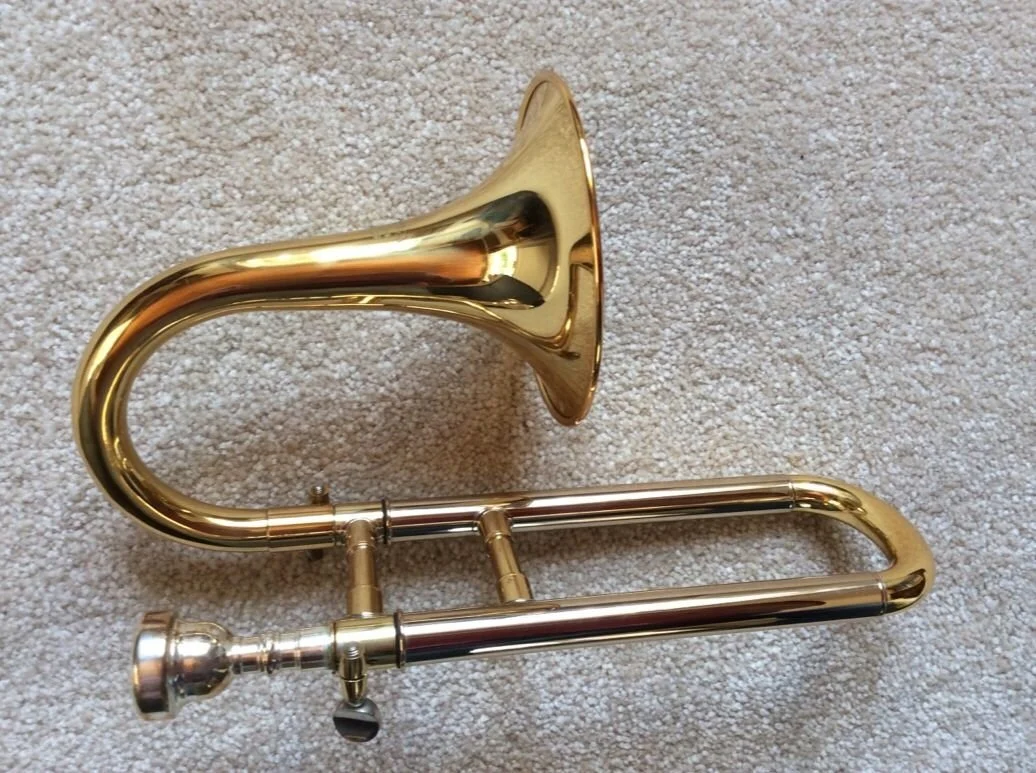

The availability of piccolos cheap enough to buy on a whim has resulted in this member of the trombone family being made and purchased far more than it really has a right to. To be fair, the same could also be said about the even cheaper and more-widely available Chinese soprano trombones. But more than anything, the piccolo trombone is a funny little horn and makes the world a little more whimsical.
The only other piccolo trombone I know of (apart from 3D-printed examples) is a one-off experiment that was made by the legendary brass technician Robb Stewart. He mentions in this article that he made it “more as a novelty or experiment” than a serious instrument, but says that it “actually does play well enough to be used in performances if used judiciously.” The article does not mention when he made this experimental piccolo, nor do I know when Thein started making theirs, but I would guess that Robb Stewart’s was first.
Robb Stewart’s B-flat piccolo trombone
The sopranino trombone has not enjoyed the same popularity as the piccolo or soprano. Quite the opposite, in fact; the sopranino is so rare that it is somewhat mythical. This is an instrument in between the soprano trombone and piccolo trombone in length and sound, sounding an octave above an alto trombone. In all of Internet history there have only been whispers of the sopranino’s existence, and we only have one video example of one being used: the famous all-trombone Peanut Vendor by the German Brass.
This video features 8 (!) different sizes of trombone, from contrabass up to piccolino. The piccolino trombone (in F, a fifth above the piccolo) was a gag horn made by Thein specifically for this bit, and unlike the piccolo it’s not fully functional. It can reportedly only play two partials, both of which are demonstrated in the video. Thein also made a page on their website for the piccolino, which makes one wonder if you can technically order one. Thein themselves refer to it as a “joke instrument”.
Two Thein piccolino trombones in F on the right, unknown other tiny trombone on the left
The sopranino in the video was also made by Thein, and can be deduced to be in F (a fifth above the soprano, or a fourth below the piccolo) by the slide positions. (For those following along, here are the timestamps: soprano 2:19, sopranino 2:45, piccolo 3:21, piccolino 4:46.)
It used to be that that German Brass video was the only visual evidence of a sopranino trombone on the entire Internet. No pictures, no other videos. I say used to be, because I finally got to see one of the handful in existence in person, and now I can present it here for the world to see!
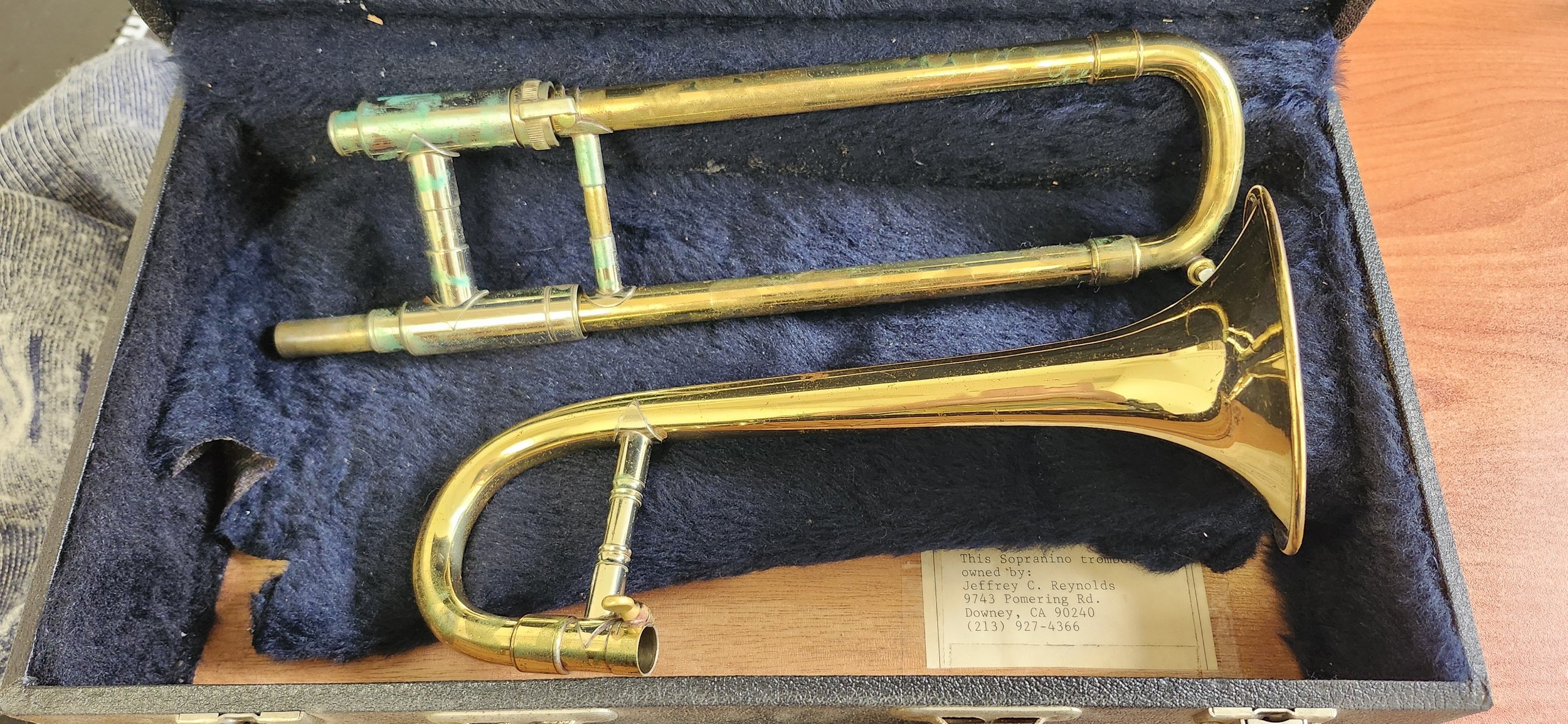
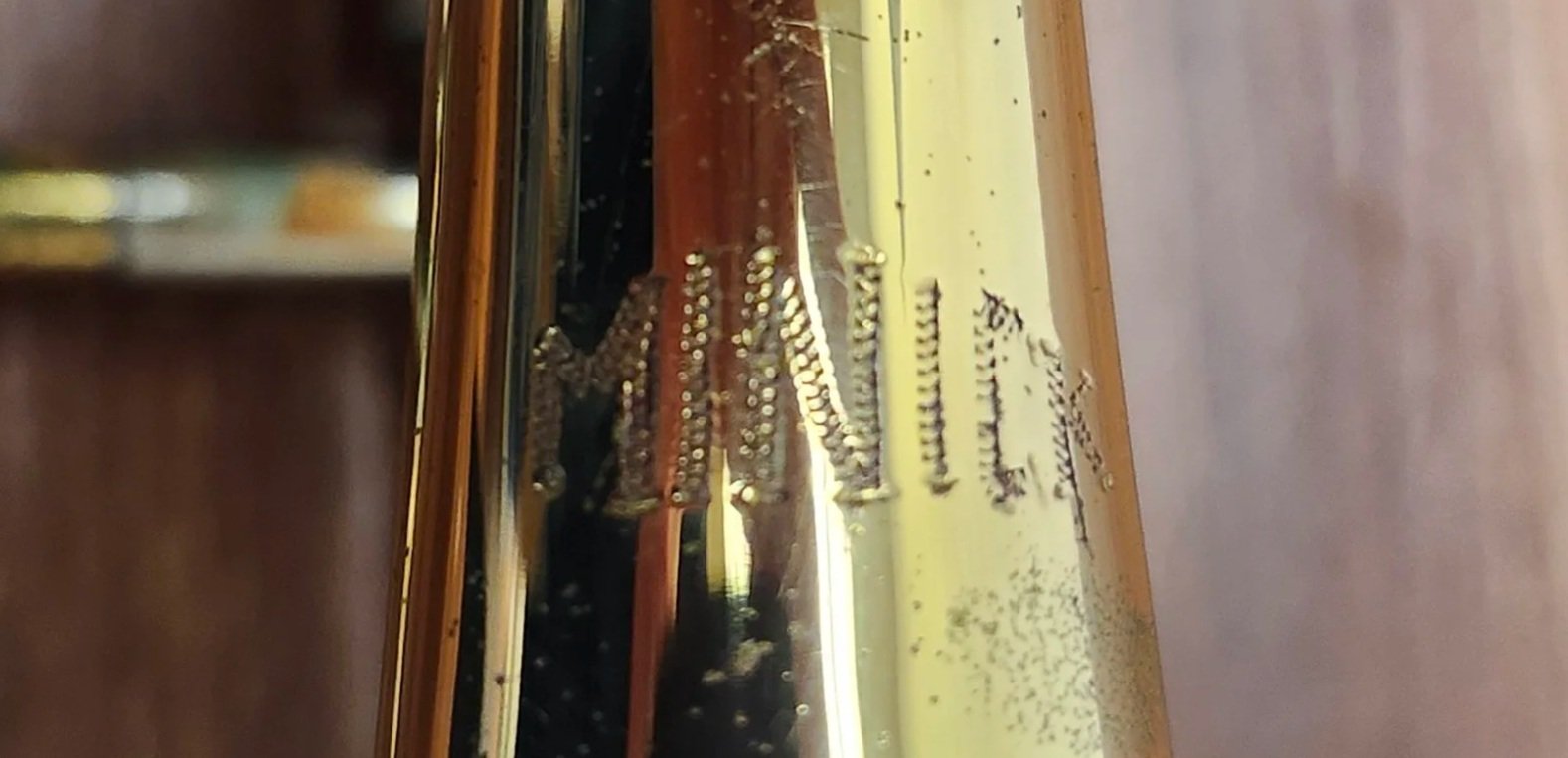
This is one of two Minick sopranino trombones in E-flat, which were made by famed brass maker and technician Larry Minick for Jeff Reynolds’ Moravian trombone choir in Downey, California. They were made with piccolo trumpet bells, and this particular one is the instrument that was built for Jeff Reynolds. Moravian trombone choir is a tradition that began in the early 18th century, using every size of trombone from soprano (or sopranino) to contrabass to play in church services. The two most famous Moravian trombone choirs in the United States are the Bethlehem Area Moravian Trombone Choir in Pennsylvania, and the aforementioned Moravian Trombone Choir of Downey. This tradition, a descendant of the German Posaunenchor, is likely the only context sopranino trombones have been used in outside of the German Brass. Having said that, a few of the top LA studio trumpeters played the Minick sopraninos in Downey choir, and it’s certainly possible that a sopranino got snuck into a recording session at one time or another.
Currently, the other Minick sopranino is owned by retired Los Angeles Philharmonic trumpeter Boyde Hood.
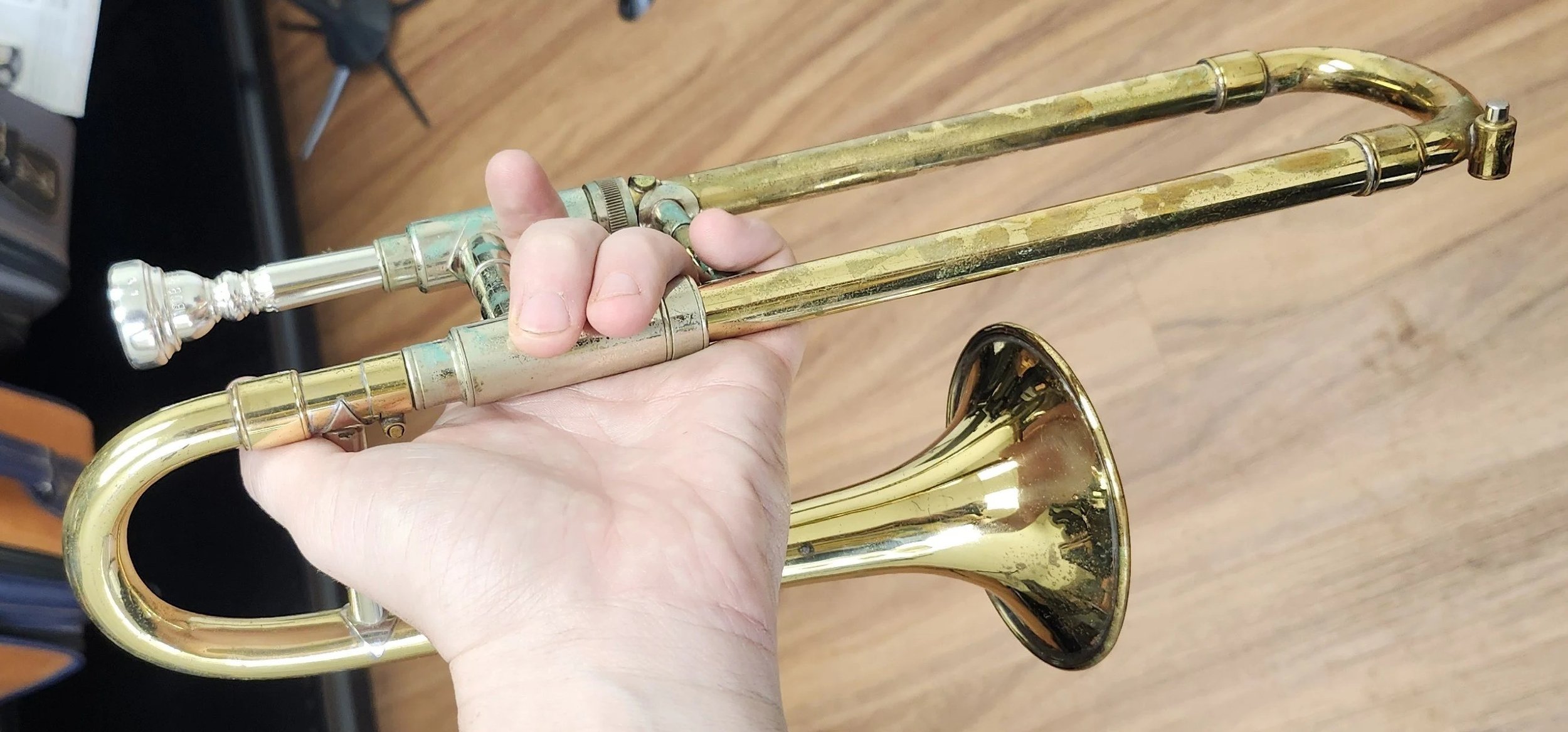
You may be wondering what the sopranino trombone sounds like, and what it’s like to play. Thankfully, I can answer both of those questions, as I was able to play the Minick sopranino!
The sopranino is difficult to play accurately, with how short the slide positions are. It’s very easy to accidentally go out a couple more positions than you intended. It does play well, as you would expect from an instrument made by Larry Minick, but its tiny dimensions betray its high-quality construction. It is a very silly instrument, but it is very fun!
Interestingly, the pedal Eb (sounding Eb3) you’d expect to be there didn’t seem to exist. Instead, the next partial that locked in when going gown from the 2nd partial (Eb4) was a Bb2, a full fourth below the expected pedal. I demonstrate that at the end of the video. Not sure why that is, but I assume it’s just a quirk of the components (piccolo trumpet bell especially) used on the instrument.
After playing the sopranino, I think it may have limited musical merit if it was made with a new, more trombone-like bell mandrel and not a piccolo trumpet bell. Perhaps there are some Eb cornet or pocket trumpet bells out there that are short enough, which is something I’ll be on the look out for. I think that while the slide is comically short, the sopranino trombone still has potential as long as it is made as well as this Minick (or the Thein in F) was, and is made with the bigger bell as mentioned. In general I think soprano trombone is probably the highest the trombone family probably needs to go in the vast majority of music, but for some edge cases and intrepid players, there could be a worthwhile niche to fill with one.